Brief History - Navajo and Apache were among the native peoples inhabiting Arizona on the arrival of the first European explorers, Franciscan Marcos de Niza, and later Francisco Vasquez de Coronado, in the mid-1500's. Spanish influence continued in the southern part of the state, largely under the guidance of Father Eusebio Francisco Kino, a Jesuit missionary, who established several missions and visitas throughout the territory.

Spain ceded Arizona to Mexico in 1821, and the US took over in 1848 after the Mexican war. The area below the Gila River was gained from Mexico in the Gadsden Purchase of 1853. The area became a territory in 1863 but continued to see unrest with the Apache wars, which ended with the surrender of Geronimo in 1886. Admission to Statehood February 14, 1912 and became the 48th state admitted to the Union.

State Name - The name Arizona derives either from the Spanish version of the Pima Indian word for "little spring place," or perhaps from the Aztec arizuma, meaning "silver-bearing."

State Nickname - The Grand Canyon State

Un-official State Nicknames
The Valentine State (Arizona became a state on February 14, 1912)
The Copper State (Arizona produces most of the nation's copper)
The Grand Canyon State (for obvious reasons)
The Baby State (Before Alaska and Hawaii joined the Union, that is)

Highest Point - Humphrey's Peak 12,633 feet
Lowest Point - Colorado River, 70 feet

State Colors - blue and old gold

State Song - “Arizona”

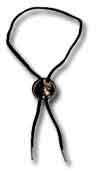
Arizona State Official Neckwear

The Bola Tie

Arizona is the only state with official state neckwear. A bola is a rope with weights attached used in South America to lasso cattle by entangling their legs. The bola tie similarly entangles the wearer's neck in ornamentation.

Designed as dress-up neckwear Mr Cedarstaff of Wickenburg, Arizona, it sure beats putting on a standard tie in hot weather. It is considered an Arizona creation and is the offical state neckwear of Arizona, signed into law in 1973. It is usually made by silversmiths and leather makers in almost every size and shape, most often with silver and turquoise.

Arizona State Tree
Palo Verde (Green Stick)
Arizona State Flower
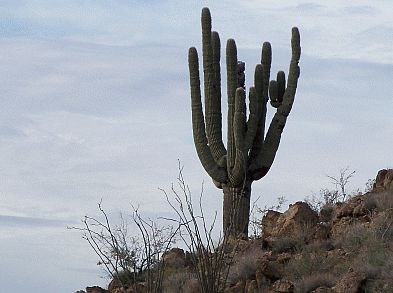
Saguaro Cactus Blossom

Arizona State Mineral
Copper

The amount of copper on the roof
of the Arizona Capitol building
is equivalent to
4,800,000 pennies.

Arizona State Bird
Cactus Wren

Arizona State Mammal
Ringtail Cat

Arizona State Fish
Apache Trout
Arizona State Reptile
Arizona Ridge-nosed Rattlesnake

Arizona State Butterfly
Two-Tailed Swallowtail

Arizona State Fossil
Petrified Wood

Arizona State Amphibian
Noble Arizona tree frog
Arizona State Gem
Turquoise
Arizona State Seal

The state seal, adopted in 1911, shows a sun over mountain peaks, a reminder of the beautiful sunsets seen in our desert. There's also a miner, complete with pick and shovel, representing Arizona's rich mines. An irrigated field with grazing cattle represents our agriculture. And perhaps most important, a dam and reservoir is a reminder that without careful water conservation and water management, we'd all have to move elsewhere.


Arizona State Flag

Arizona was the last of the lower 48 to become a state. The flag that resulted was this country's symbol longer than any other. The 13 rays of red and gold on the top half represent both the 13 original colonies of the Union, and the rays of the Western setting sun. Red and gold were also the colors carried by Coronado's Spanish expedition in search of the Seven Cities of Cibola in 1540.

The bottom half of the flag has the same Liberty blue as the United States flag. The blue field of the Arizona flag is a tribute to the blue of the Union flag.

Since Arizona was the largest producer of copper in the nation, a copper star was placed in the flag's center. The copper colored star in the center of the flag represents Arizona's status as the largest producer of copper in the nation.

The Arizona state flag was designed by Colonel Charles W. Harris, who served as Adjutant General of the state intermittently between 1912 and 1928. Colonel Harris took both history and color into consideration in his design.

The red and yellow are a nod to the Spanish Conquistadors, who, led by Coronado, traveled through Arizona in 1540 in a vain quest for the Seven Cities of Cibola; the Conquistadors carried red and gold.

The red and yellow colors are arranged in rays around the top of the star, depicting the unique beauty of an Arizona sunset. The first Arizona flag was sewn by Nan D. Hayden.

The USS Arizona Memorial as a national shrine symbolizes American sacrifice and resolve.

The battleship USS Arizona bears a state's name because when it was build the battleship was the mightiest ship of the Navy, and the mightiest ships were required, by law, to be named after a state. The rule since Congress first gave the Secretary of the Navy authority to name ships in 1819 has been: First class ships are named after states, second class ships after rivers, and third class ships after cities and towns. The reason the Secretary chose Arizona may be subject to speculation, but Arizona's admission as a state a mere two years before construction began on battleship may have helped the choice along.


National Park Service Website

Arizona has 60% of all types of wildlife species found in North America. Big game species include javelina, bear, elk, antelope, big horn sheep, bison, mule deer, white tail deer, mountain lion, and turkey.

Arizona has the largest stand of ponderosa pines in the world. Arizona also has more parks and national monuments than any other state, more mountains than Switzerland, and more golf courses than Scotland.

The best-preserved meteor crater in America is located near Winslow, Arizona. Nearly 50,000 years ago, the huge nickel-iron meteor, weighing a few hundred thousand tons and traveling at a speed of upwards of five to ten miles per second, slammed into the earth with such force that it destroyed all life for a hundred-mile radius. The crater measures 4150 feet rim-to-rim and is 570 feet deep.

Cities & Towns
by County
Water Recreation Areas
Lake Powell
Lake Mead
Lake Havasu
Lake Mohave

Tell A Friend
About This Website!
Copyright Notice Hualapai West, Inc. . All rights reserved.